In which the author explains how socialism is morphing into a feminist defense of affordable parenthood and apple pie.
I have long described myself as a socialist feminist. I love the word pinko, because it has a vintage glow. Time magazine used it in 1925 as a snappy way of altering the term “pink,” long used to imply that leftist tendencies were effeminate, as in “parlor pinks,” a term the Wall Street Journal applied to progressive politicians. Joe McCarthy loved to hate pinkos, and Richard Nixon’s notoriously gendered 1950 campaign against Helen Gahagan Douglas portrayed her as the “Pink Lady”—“pink right down to her underwear.” Governor George Wallace of Alabama campaigned against “the left-wing pinko press” and (my personal favorite), “pseudo-pinko intellectuals.”
Many pinkos have taken grief from the Left as well as the Right. When British Labour Party leaders leaned centrist, they were often accused of diluting red principles, as in a little ditty from the 1950s: “The people’s flag is palest pink, mum washed it in the kitchen sink.” According to Wikipedia, the same phrase came up again in the 1960s. Is the allusion to “mum and the kitchen sink” incidental? I don’t think so. Red for blood, and the red-blooded; pink apparently for little girls, women’s underwear, and dishtowels.
In 2024, name-caller-in-chief Donald Trump repeatedly labeled Kamala Harris a socialist, Marxist, or communist, sometimes calling her “Comrade Kamala” (he referred in particular to her proposal for federal action against grocery-price gouging). Happily, his fondness for such pejoratives seems to have had the effect of sapping their negativity. Though the red-and-pink- baiting continues, democratic socialism is enjoying a political moment.
More than a moment—it’s moving the hands of the U.S. political clock leftward and reshaping the midterm elections. Many pundits are now on the case. Paul Krugman insists that there are very few actual socialists in the country because most who claim allegiance are social democrats by another name. He defines “real socialism” (of which he disapproves) as “government ownership of the means of production.” By his account, a mere rebranding exercise is underway.
I disagree. The meaning of socialism (like the meaning of capitalism) has long been a tangle of ideas sparking a multilateral tug of war. After all, Karl Marx’s favorite Latin saying was “De omnibus disputandum,” which translates to “argue about everything.”
Socialist activism in Great Britain and Europe long predated the publication of Capital, a book that had far more to say about the rate of profit than the process of social reproduction. My all-time favorite early socialists were the Irish collaborators William Thompson and Anna Wheeler, deeply animated by support for women’s suffrage. They reached well beyond the discourse of rights to insist that women’s commitment to the care of others meant that they would never achieve equality in an economy based entirely on competition (see my history of economic ideas, Greed, Lust, and Gender).
Karl Marx and Friedrich Engels rejected their socialist predecessors as utopian and (worse) “unscientific” but failed to quash their legacy. In the early twentieth century, the British Fabian Socialists advocated efforts to gradually influence existing political parties, civil servants, and local governments. Both Lenin and Trotsky attacked them as pedantic careerists and opportunists betraying the working class, and Fabian writers like George Bernard Shaw are seldom taken seriously by left intellectuals today.
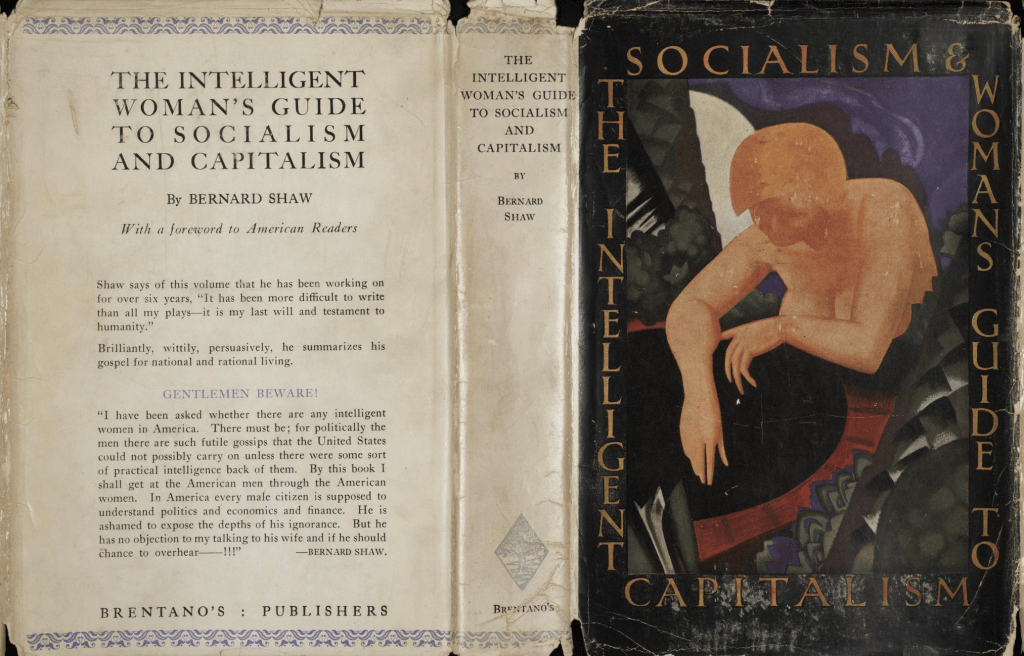
But Shaw made radical—and distinctly feminist—arguments in favor of economic equality. In his Intelligent Woman’s Guide to Socialism and Capitalism, published in 1928, he wrote:
Everybody knows now that Socialism is a proposal to divide-up the income of the country in a new way…The only possible difference of opinion is not as to whether it should be divided or not, but as to how much each person should have, and on what conditions he should be allowed to have it. St. Paul said “He that will not work, neither shall he eat” but as he was only a man with a low opinion of women, he forgot the babies. Babies cannot work and are shockingly greedy; but if they were not fed there would soon be nobody left alive in the world. So that will not do. (p. 6)
Shaw challenged the labor theory of value on the grounds that no one could possibly measure exactly what an individual worker contributed to the value of output (in my view, a challenge that neither Marxist nor mainstream economists have adequately met). He described “bringing up a family” as the “greatest social service that can be rendered” but observed that “as there is nothing to sell, there is a very general disposition to regard a married woman’s work as no work at all and take it as a matter of course that she should not be paid for it.” (p. 25).
In the early twentieth-century United States, the Socialist Party led by Eugene Debs was a heterogeneous coalition of trade unionists, Christian socialists, municipal reformers, and democratic radicals who were not much interested in nationalization but were deeply committed to cooperative ownership, public utilities, and the democratic regulation of economic life. Charlotte Perkins Gilman, an admirer of Debs though not a member of the Socialist Party (which she considered too Marxist) famously insisted on the need to socialize many of the care services relegated to women in the home.
Sound familiar? I have quibbles with everyone mentioned above, but their priorities resonate with those of the Democratic Socialists of America (DSA), the organization that has recently upended several elections, putting pressure on the mainstream of the Democratic Party.
In 2019, DSA adopted a national resolution supporting guaranteed paid parental leave and public universal child care and preschool and specified that candidates seeking a national DSA endorsement should support these policies. Zohran Mamdani, now mayor of New York City and a DSA member, campaigned on an “affordability” agenda that centered free public child care.
Not all self-proclaimed democratic socialists belong to DSA. Harold Meyerson observes that fewer than 1 percent of Americans who identify as socialists are dues-paying DSA members. Still, they tend to share the organization’s concern for social reproduction. Senator Bernie Sanders strongly advocates universal child care and pre-K, along with Medicare for All—both to be funded in part by a new wealth tax. In the House of Representatives, Alexandria Ocasio-Cortez (AOC) and Rashida Tlaib have fiercely supported child care, paid family leave, and Medicare for All throughout their congressional careers.
What makes these demands socialist is not that they require more government spending. They aim to remove essential goods and services from dependence on private purchasing power, socialize costs now imposed on families, and finance their provision by challenging concentrated claims on income and wealth. Democratic socialism, in this sense, is less about government ownership of every factory than about democratic control over the resources required to produce, develop, and maintain human capabilities.
It’s hard even for young single adults to cope with the growing cost of housing, health insurance, and education; it’s harder still for those caring for family and community members who are young, ill, disabled, frail, or economically insecure. Much of this care is still treated as economically “unproductive” because it is provided without pay and therefore does not pass through the marketplace.
Here’s where socialist reasoning clicks in. Our families and communities, like our natural environment, generate public benefits that markets neither adequately value nor reliably ensure.Their provision deserves public protection and support for economic as well as moral and political reasons—our future depends on them.
There is nothing “utopian” about democratic socialism. What is utopian is the conviction that a larger economic pie will automatically sustain the people who bake it, serve it, and raise the next generation. An economy that neglects its means of reproduction eventually undermines its means of production as well.
