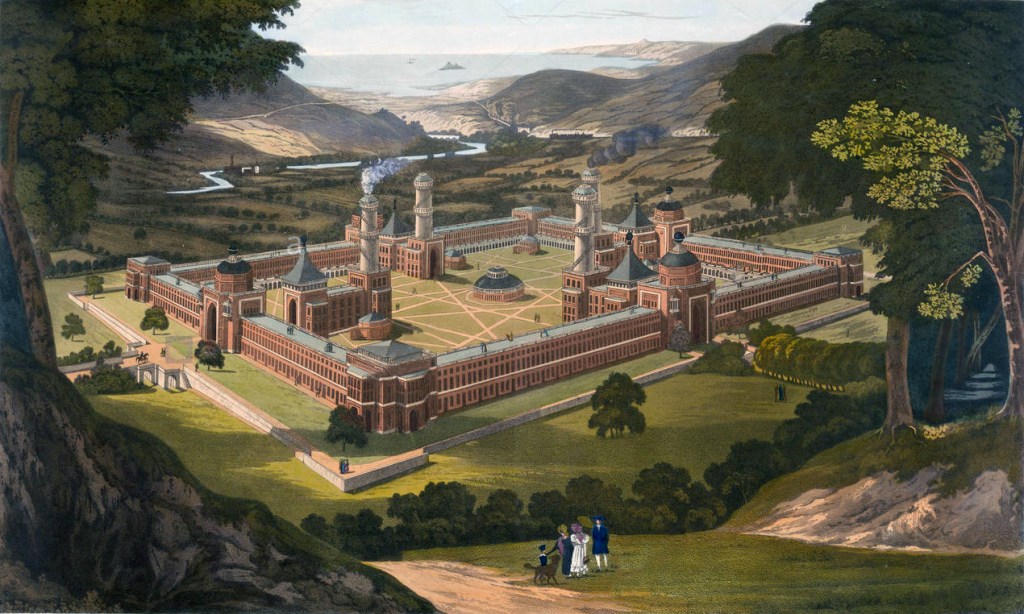
A bird’s eye view of a community in New Harmony, Indiana, United States, as proposed by Robert Owen. Engraving by F. Bate, London 1838.
It’s not easy. We need to cooperate with one another to produce and protect goods and services that can’t be adequately provided through market exchange alone. Here’s the catch: the social capabilities that make cooperation possible—trust, mutual concern, and a willingness to do one’s share—must somehow be cultivated and sustained.
Cooperation helps produce public goods, but public goods also help produce cooperation.
The simplest versions of conventional economic theory obscure this circularity. They focus on voluntary exchanges between consenting adults who are presumed to know exactly what they want. No wonder the textbook version sometimes implies that we live in the best of all possible worlds.
Shop until you drop. Those of us with credit cards don’t usually find it hard to decide on our own what we want to buy or sell; many such transactions can be successfully conducted without any contact with actual humans.
Some other important activities require not merely contact with other people but cooperation—an investment of time, money, or effort in pursuit of a shared goal. Call this teamwork. It invites at least some dedication to collective success. As coaches—and viewers of Ted Lasso—like to put it, there’s no “I” in team.
The relevance of teaminess extends well beyond sports, including benevolent actions (like taking care of friends and family) and malevolent actions (like making war). Most successful businesses try to promote team spirit. Both economics and history are shaped by individuals cooperating with one another in team-based competition.
Voluntary cooperation is especially important for managing public goods and shared resources that can’t be easily governed by ordinary market exchange or top-down rules. Most of us are aware of the depletion and deterioration of natural assets such as forests, fisheries, and potable water. Public goods include services such as crop pollination by insects and protection against soil erosion. The global climate itself can be construed as a free service that we have long taken for granted.
Not everything public is good. Climate stability is a public good; climate change is a public bad. And while “climate” usually refers to the meteorological, we can also speak of a social climate featuring varying levels of safety, trust, concern for others, and the ability to cooperate.
A 2025 White House estimate put the economic cost of the illicit opioid epidemic in the U.S. at $2.7 trillion for the year 2023, including the cost of lives lost (a calculation that I’ll interrogate in a later post). Low-income, less-educated communities have been disproportionately hard hit.
Once the “social climate” enters the picture, the circularity becomes apparent. The capacity to cooperate is not simply an individual trait. It is shaped by the economic environment. And economic reasoning itself can help us understand this. “Free-rider problems” emerge when individuals realize they can enjoy a share of the benefits without sharing the costs—as in jumping the turnstile.
This is not mere paranoia. Free-riding can be a way of exploiting others, claiming a share of the benefits they create without fully sharing the costs. If individual free-riding is conspicuous, it tempts others to free-ride themselves, or simply to opt out of the group. Nobody wants to be a sucker. Cooperation can unravel, especially if the benefits are relatively small, or if it’s hard to tell how much others are contributing compared to what they are consuming.
This is why we rely on rules and laws (as well as turnstiles). But willingness to establish, obey, and enforce rules depends partly on confidence in their legitimacy. Corruption undermines that confidence and can even lead to anarchy.
Rules alone are not enough. Cooperation often depends not only on trust but also on affection and concern for others. These are factors that many economists consider outside their purview—they are easily labeled mere “preferences” that are not susceptible to economic analysis. But these preferences are not fixed. As Nobel laureate Elinor Ostrom has explained, social interaction and institutional rules can foster—or undermine—them.
Trust, along with the relationships and social norms that help sustain it, is often bundled under the label “social capital.” Nineteenth-century socialists like William Thompson, Emma Wheeler, and Robert Owen recognized the importance of these ingredients long ago but would cringe at the label. Teaminess is not something you can deposit in a bank, and it’s hard to measure its individual rate of return.
Social scientists increasingly treat cooperation as an empirical question, using experiments and cross-cultural comparisons to investigate when it emerges, when it breaks down, and how it can be sustained. We see considerable variation across space and time in the level of social costs imposed by problems such as drug addiction, alcoholism, suicide, crime, poverty, and physical and mental illness. This variation seems related to a variety of social conditions, including economic inequality.
So, to understand public goods, we need to understand cooperation—but to understand cooperation, we need to understand how public goods are produced. The next few posts will follow this circle, beginning with a basic question: Are goods public because of their inherent characteristics, or because social institutions determine who pays for them, who gets them, and who is excluded from them?
