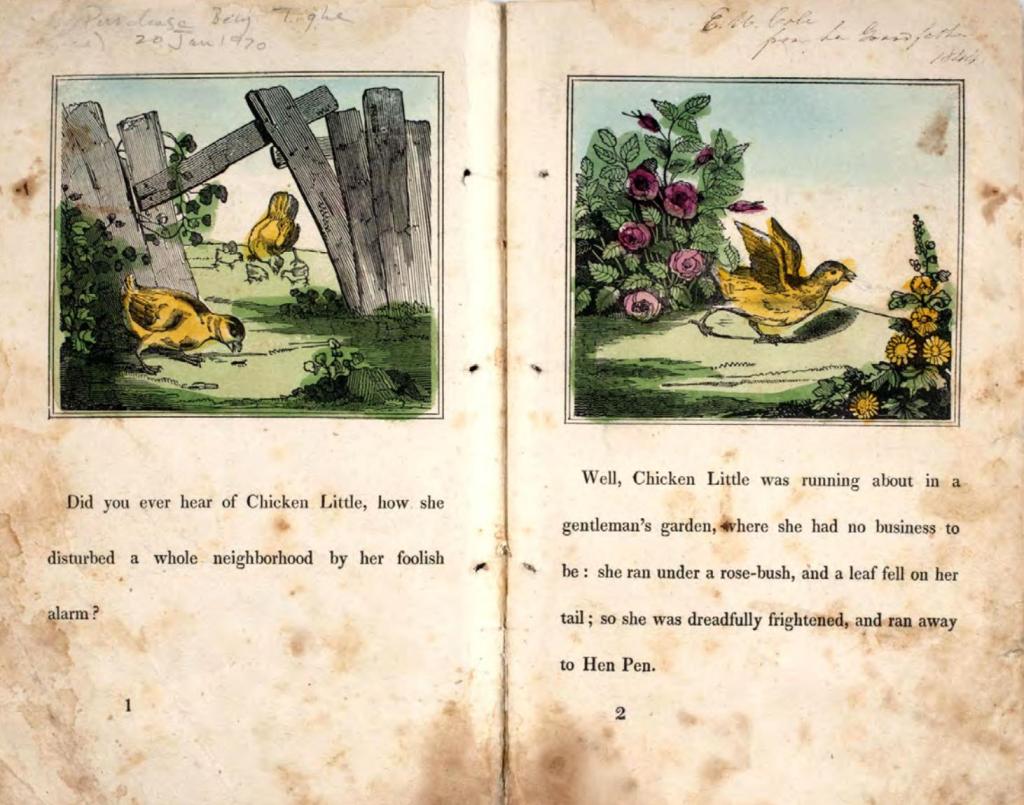
This title is just a tease, since there are no wolves on the Titanic, only deck chairs and ballrooms. Chicken Little Cassandra Girl or CLCG (See-El-See-Gee, as she likes to call herself, accent on the second syllable, as in Eurydice) is on stage, doing her song and dance. Her comedy routine is heavy on apocalypse, and she does an excellent imitation of Elon Musk, Mars and all. She is largely ignored by the clientele, who are just now chasing their prix-fixe chocolate raspberry mousse with a round of Brandy Alexanders.
Next, she dons an 18th-century wig and does an imitation of Jonathan Edwards, reading from his 1741 sermon, “Sinners in the Hands of an Angry God.”Then, she segues to conservative George Will in the Washington Post: bewailing “the nation’s accelerating self-assassination” and invoking the phrase “total Boomer Luxury Communism.” She notes that an article in that bulwark of British financial complacency, The Economist magazine, explains that “American capitalism has taken an apocalyptic turn.” Nothing gooses the desire to accumulate capital more than the fear that you will soon be replaced by a Large Language Model.
Without losing steam, CLCG poses as Wonder Woman wielding the Lasso of Truth, the weapon that forces those whom it encircles to say nothing but what they truly mean. Then she morphs into a versatile, debuff-extending champion from the Demonspawn faction—gamer-speak for one who weakens an opponent’s powers. Perhaps it can be directed at the Powers That Be—but we need more than a debuff. We need a list of suspects, a trail of evidence, a successful prosecution. We need to find the perps of this crime against the future.
CLCG drops the costume, steps off stage, and hands the mic to a historian. Edward Gibbon published the first volume of The Decline and Fall of the Roman Empire in 1776, the same year that Adam Smith published The Wealth of Nations and revolutionaries in the U.S. penned the Declaration of Independence. A new kind of empire was emerging, igniting debates about its past and its future, its virtues, vices, and possible criminalities.
Political economy developed as an effort to explain who benefited from this new order and why, raising questions about property rights, the distribution of income, and the concept of exploitation. Adam Smith was an optimist, confident that moral sentiments would temper the pursuit of self-interest in the competitive marketplace. Many of his immediate successors, such as David Ricardo, were less cheerful.
Ricardo scandalized many of his contemporaries by showing how landlords could collect rising rents simply because they owned scarce land, contributing little or nothing to actual production. Ricardo carefully distinguished the rent-receiving landlord from the productive capitalist, but early socialists like William Thompson extended the “unearned income” accusation from ownership of land to ownership of capital. Karl Marx famously developed a theory of exploitation in Capital, a book whose title names the commanding force in what later came to be called capitalism.
The concept of exploitation often reaches behind the process of voluntary exchange to ask how men and women acquire the resources that they bring with them to the market. More broadly, it asks how differences in bargaining power—whether based on physical prowess, ownership, political control, or cultural influence—can influence transactions. It asks how wolves find their prey.
The consequences of “capitalism” and “socialism” depend heavily on the hierarchies of bargaining power embedded within them. “Capitalism” might work pretty well if wage earners had as much bargaining power as their employers, and “socialism” might work pretty well if it were truly democratic.
Both putative systems might work better if they looked beyond control over the “means of production” to consider control over the “means of reproduction”—the organization of care for dependents and future generations. This is CLCG’s main point, and it embodies her attention to feminist theory as a challenge to—and extension of—political economy.
Many, many others, including Nancy Fraser, Emma Dowling, Robert Gottlieb, and the members of the Care Collective, have pointed to a “crisis of care.” What started out as a concern about “balancing work and family” now points to a triangle of problems: families lack time and income for unpaid care; users cannot obtain affordable, reliable services; and care providers cannot recruit or retain workers at prevailing wages.
The issue has been dramatized by concerns about persistent below-replacement fertility on a global level, and it clearly has a gender dimension. Economist Claudia Goldin puts it this way in a recent essay: “As women have gained more agency, a mismatch has emerged between what they need to enjoy the fruits of their autonomy and the credible commitments men can make.”
But there is also a larger problem: effective care provision is crucial to the sustainability of our social climate—our ability to cooperate to address problems that markets cannot solve. You can point to a weakening of solidarity or a depletion of social capital. You can refer to care provision as a public good or part of the commons. I use the term social climate to highlight the parallels between feminist and ecological economics, both emphasizing that the “market” is but a small part of our economy, which is, in turn, a small part of our planetary ecosystem.
Climate change and pollution—social as well as physical—are the wolves at our door, threatening to blow our houses down even as the sky is falling. We can’t survive without a better understanding of the social divisions and collective conflicts that make it difficult for us to take good care of ourselves.
I put “capitalism” and “socialism” in quotation marks, because so much depends on how exactly these words are defined and what their conventional definitions leave out. I will turn to that issue in my next post, with help from CLCG.
