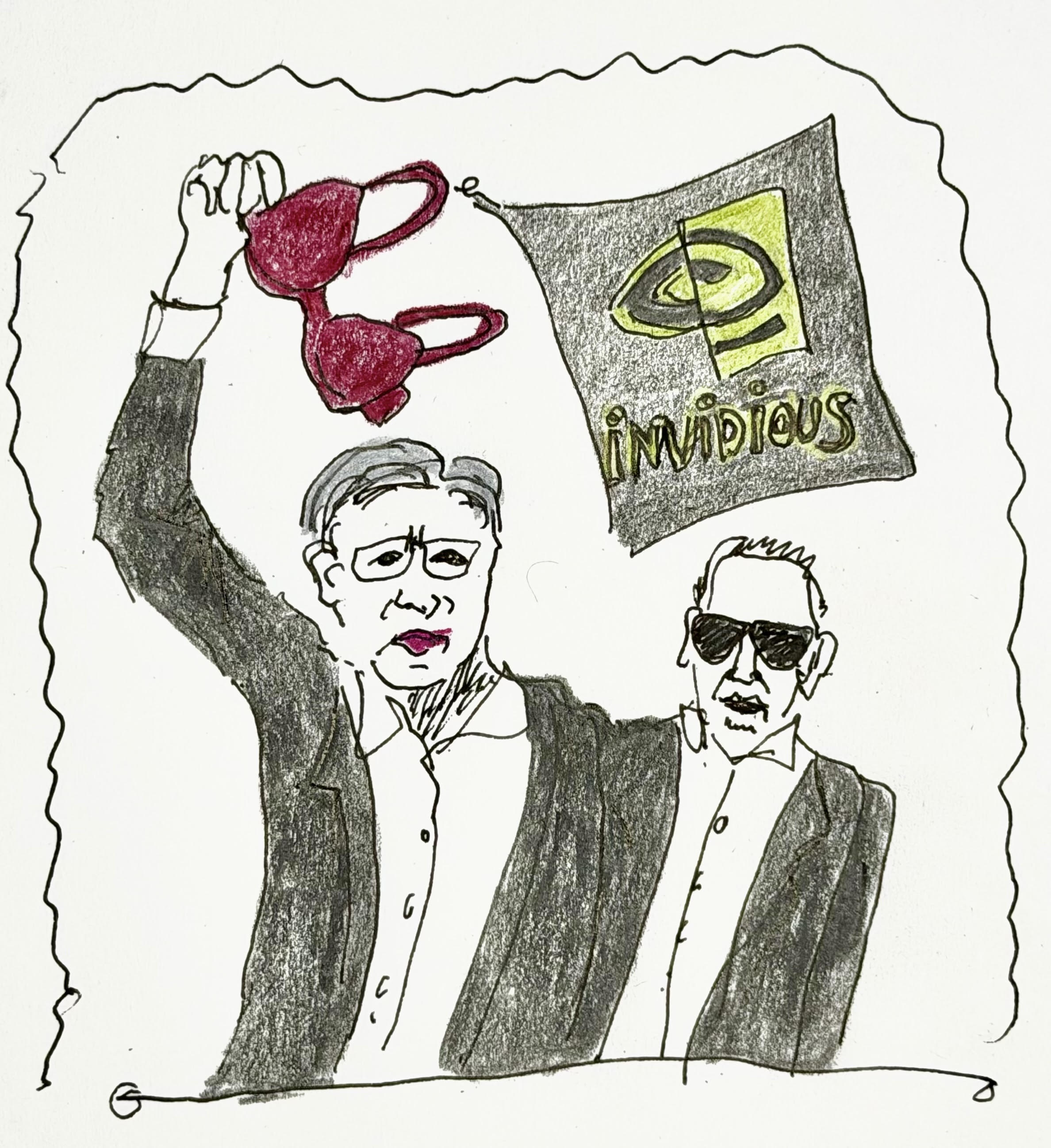
Global markets in turmoil as world hunts for the most famous undergarment in history.
THIS JUST IN FROM INN: THE IMAGINARY NEWS NETWORK
(“All the news that fits, and some that doesn’t”).
Good evening. On Monday, eleven days after resigning in a scandal that wiped out a trillion dollars or so of market value, the chief executive of the world’s most valuable chipmaker was reinstated by his board. Within hours, the president marked the occasion on Truth Social with a meme depicting the returning executive as a bloodied warrior, fist raised against a blue sky — the composition borrowed from a famous campaign photograph of the president himself — clutching not a flag but a red brassiere. “Sex sells, fellas,” the president told CNBC. By Tuesday morning, the bra had more followers than most nations. Tonight, INN asks the questions everyone is asking: Where did it come from? What did it cost? And who will own it?
The provenance question
Our first stop is the Institute for Applied Lingerie Forensics, where senior analyst Dr. Marguerite Underwood has been studying the image around the clock. “The underwire suggests a molded contour cup, and the shade is somewhere between Lipstick Red and Regret,” she told INN, adjusting her magnifying loupe. “The question everyone wants answered is whether it was made in Shenzhen or sold at a mall in Ohio. Frankly, the supply chain for this garment is as complicated as the supply chain for a graphics processor.”
Supporters of the Made-in-China theory point to the stitching, which they describe as “suspiciously efficient.” The Victoria’s Secret camp notes the confident angle of the straps. A third faction, growing by the hour, argues that the bra was never manufactured at all. “It’s pixels,” said Dr. Underwood, setting down her loupe with a sigh. “Rendered, almost certainly, on the company’s own chips. It may be the first undergarment in history to be both counterfeit and original at the same time.”
Estimates of its retail value range from $14.99 to “priceless,” depending on whether you count the market capitalization it may have erased.
The knockoff boom
None of this has slowed the apparel industry. Fast-fashion retailers released their first Triumphant Red knockoffs within nine hours of the meme’s appearance, a production cycle that analysts called “breathtaking” and labor advocates called “exactly what we were afraid of.” One discount site is offering a three-pack for $11.40, with free shipping and a matching tie. Department stores report that customers are asking for the bra by name, though no one can agree on what the name is.
A spokesperson for the Coalition of Independent Lingerie Designers expressed frustration. “We have been making beautiful, durable, ethically sourced red bras for decades,” she said. “Nobody cared until one appeared in a meme about a man.”
The auction
Meanwhile, the venerable auction house of Bidwell & Thrush has announced the sale of what it describes as “the original,” accompanied by a certificate of authenticity, a blockchain token, and a sworn affidavit from a gentleman who says he was standing just outside the frame. Bidding opened at $50,000 and passed $2.3 million by Tuesday morning. The leading bidders reportedly include a hedge fund, a crypto collective, two sovereign wealth funds, and a retired orthodontist from Boca Raton who told INN he “just wants to feel part of history.”
The prediction market Probabli has opened more than four hundred contracts on the outcome. Current odds favor the hedge fund at 41 percent, the orthodontist at 9 percent, and “the bra turns out not to exist” at 33 percent — a figure Probabli’s chief economist called “irrationally high, though I personally hold a large position.” Regulators have declined to say whether betting on the sale of an object that may not exist constitutes gambling, securities trading, or performance art. Probabli also confirmed that, two weeks ago, it had offered 3 percent odds that the executive would be back in his job before Thanksgiving. “We regret nothing,” said the chief economist, “except that one.”
Big Pharma enters the chat
Perhaps the fiercest competition is among pharmaceutical companies seeking rights to the image for advertising campaigns. At least three firms preparing to launch new erectile dysfunction treatments have retained intellectual property lawyers, though progress has been slowed by a technical complication: the face in the meme belongs to a man who has been too busy being un-fired to return anyone’s calls. One agency has proposed simply replacing the face with a stock actor. “The bra is the brand,” said a creative director who asked not to be named. “The man is interchangeable. Honestly, that’s always been our thesis.” A draft slogan obtained by INN reads: “Ask your doctor if triumph is right for you.”
The discourse
On the more rarefied corners of social media, scholars have wasted no time deconstructing the image. A widely shared thread by a professor of comparative iconography traces the “raised trophy” motif from Genghis Khan’s victory banners through Vlad the Impaler’s preferred methods of public communication to the modern sports championship. “The triumphant warrior brandishing proof of conquest is one of humanity’s oldest visual clichés,” she writes. “What’s new is that the trophy is lingerie and the battlefield is a quarterly earnings call.”
A rival, more popular thread consists entirely of the bra photoshopped onto the Statue of Liberty.
Feminist economists, reached for comment, noted that in the history of patriarchal systems, the women who actually made the underwear have rarely been the ones who profited from it. “Somewhere, a garment worker earned perhaps forty cents for sewing the real version of this thing,” said one. “She is not bidding in the auction.”
From the business desk
Finally, a reality check from our business correspondent, who notes that the numbers in this story are, unfortunately, not imaginary. Between its record close in early October and the depths of the scandal, the chipmaker lost roughly $1.8 trillion in market value. On Monday, the day of the reinstatement, its shares jumped about 31 percent, adding something on the order of a trillion dollars in a single session and bringing the company back to roughly $4 trillion. According to the Federal Reserve, the entire net worth of the bottom half of American households — about 66 million households, every home, car, savings account and retirement fund, minus every mortgage and credit card balance — came to $4.28 trillion in mid-2026.
In other words, one company is worth roughly as much as everything owned by half the country. Over a few weeks it lost an amount equal to more than 40 percent of that half’s total wealth, then got back nearly a quarter of it in one Monday — over a scandal, a reinstatement, and a red bra that may not exist.
“Markets are forward-looking,” our correspondent concluded. “So is the bottom 50 percent. They’re looking forward to the next election.”
That’s the news. INN will continue to follow the bra wherever it leads. Good night and good luck.
NOTE: The numbers in the business segment are not imaginary. Sources: Axios, November 23, 2026 (“Trump’s tribute to Jensen Huang’s comeback: ‘Sex sells’”); Nvidia press release, November 23, 2026; CNN and Yahoo Finance, November 23, 2026, on the 31% share gain; Euronews, November 13, 2026, on the $1.8 trillion loss; Federal Reserve Distributional Financial Accounts, net worth of the bottom 50% (FRED series WFRBLB50107), Q2 2026. The roughly $1 trillion one-day gain and $4 trillion value are estimates from the share price and Nvidia’s roughly 24.3 billion shares outstanding.
One response to “The Red Bra”
A , B, C, D or DD cup? Thanks for a laugh!